
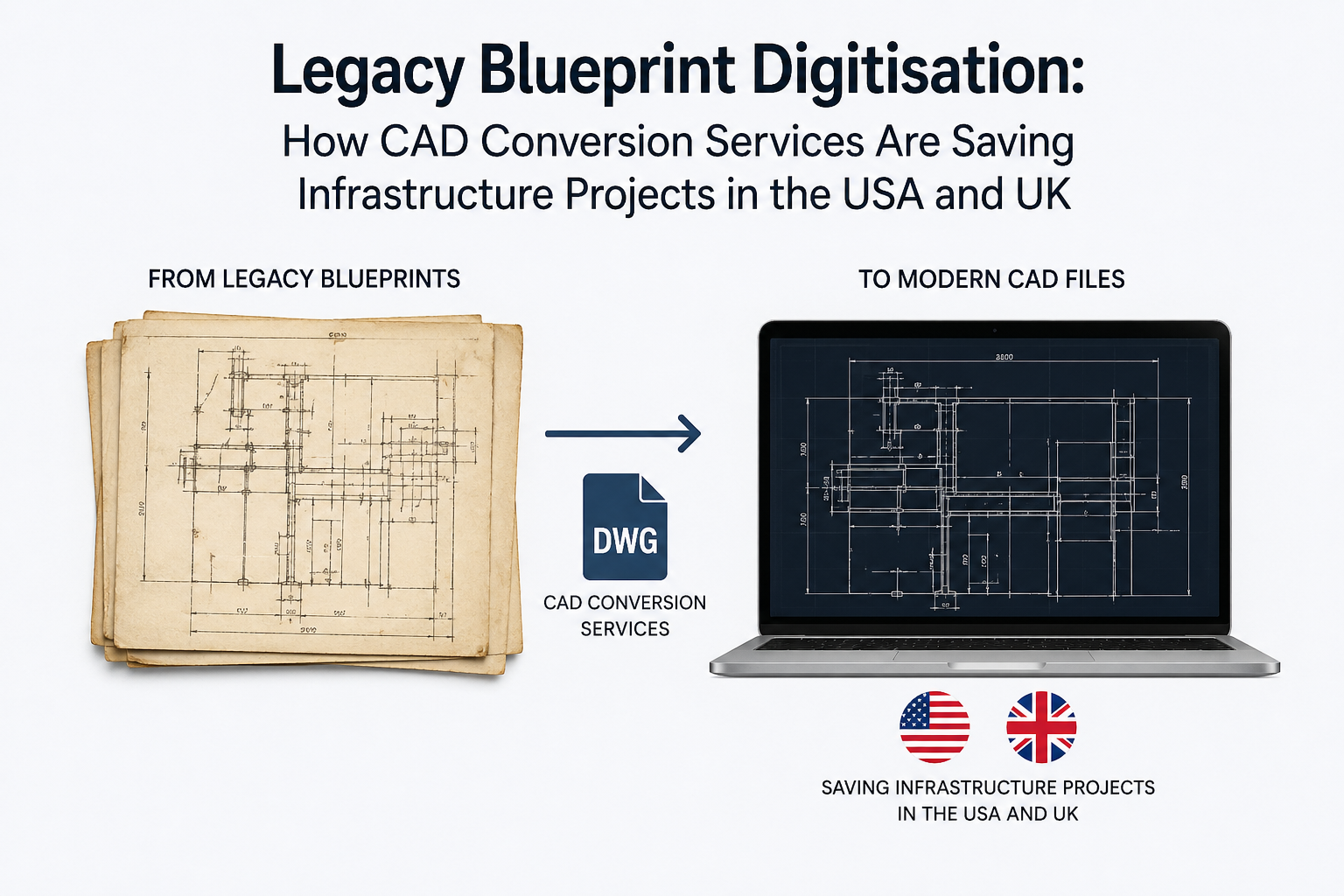
Legacy Blueprint Digitisation: How CAD Conversion Services Are Saving Infrastructure Projects in the USA and UK
Across the USA and UK, thousands of infrastructure projects still rely on legacy blueprints paper drawings, scanned PDFs, and outdated design files created decades ago. While these documents hold valuable historical data, they also present a serious challenge in today’s fast-paced, digitally driven construction and engineering environment.
From railway expansions in the UK to highway rehabilitation projects in the United States, inaccurate or outdated drawings can lead to delays, cost overruns, compliance issues, and even safety risks. This is where autocad conversion services are stepping in as a critical solution bridging the gap between legacy data and modern project execution.
In this article, we’ll explore how CAD Conversion Services are transforming infrastructure workflows, the key challenges they solve, and why businesses across the UK and USA are rapidly adopting them.
What Is Legacy Blueprint Digitization and Why Does It Matter?
Legacy blueprint digitization is the process of converting old physical drawings, scanned documents, or PDFs into editable, accurate CAD formats such as DWG or DXF.
Why is this important today?
Because modern infrastructure projects demand:
- Real-time collaboration
- Precision engineering
- BIM (Building Information Modeling) integration
- Regulatory compliance
- Faster project turnaround
Without digitization, legacy blueprints become bottlenecks instead of assets.
According to industry research by McKinsey, large construction projects typically take 20% longer to finish than scheduled and exceed budgets by up to 80% often due to poor data management and outdated documentation.
Digitizing these blueprints using pdf to autocad conversion services ensures that critical project data becomes accessible, editable, and usable in modern design ecosystems.
Why Are Infrastructure Projects in the USA and UK Still Using Legacy Drawings?
Despite rapid technological advancement, many infrastructure systems in the USA and UK were built decades ago. Their documentation exists in formats such as:
- Hand-drawn blueprints
- Scanned PDFs
- Microfilm archives
- Non-editable CAD formats
Common reasons for continued reliance:
- Historical infrastructure (bridges, railways, utilities)
- Lack of digitization budgets in earlier phases
- Complexity of converting large archives
- Regulatory requirements to preserve original documents
However, continuing to rely on these outdated formats creates inefficiencies and risks.
What Problems Do Legacy Blueprints Cause in Modern Projects?
1. Inaccurate Measurements and Errors
Manual drawings often contain inconsistencies that lead to design conflicts.
2. Time-Consuming Rework
Engineers must redraw or reinterpret data, slowing down project timelines.
3. Poor Collaboration
Non-digital formats cannot be easily shared or updated across teams.
4. Compliance Risks
Regulatory bodies in the UK and USA increasingly require digital documentation.
5. Increased Costs
Errors caused by outdated drawings can lead to expensive on-site corrections.
A study by the National Institute of Standards and Technology (NIST) found that inadequate interoperability in construction costs the U.S. industry over $15 billion annually.
How Are CAD Conversion Services Solving These Challenges?
Modern CAD Conversion Services are designed to transform outdated drawings into precise, scalable, and editable CAD files.
Key benefits include:
✔ Improved Accuracy
Professional conversion ensures every line, dimension, and annotation is recreated with precision using an accurate cad conversion service.
✔ Faster Project Execution
Digitized files eliminate the need for manual redrawing, saving weeks or even months.
✔ Seamless Integration with BIM
CAD files can be easily integrated into BIM workflows, enabling smarter planning and execution.
✔ Enhanced Collaboration
Teams across locations can access and update digital drawings in real-time.
✔ Better Compliance
Digitized documentation meets modern regulatory standards in both the UK and USA.
How Does PDF to AutoCAD Conversion Work?
The process of pdf to autocad conversion services is more than just file conversion it’s a detailed and technical workflow.
Typical process includes:
- Data Assessment
- Reviewing blueprint quality and complexity
- Pre-processing
- Cleaning scanned images and enhancing clarity
- Conversion
- Redrawing or vectorizing into AutoCAD format
- Layering & Structuring
- Organizing elements into logical layers
- Quality Check
- Ensuring dimensional accuracy and compliance
- Final Delivery
- Providing editable DWG/DXF files
This structured approach ensures that the final output is not only accurate but also ready for real-world application.
What Are the Latest Trends in CAD Conversion for Infrastructure?
1. AI-Powered Conversion Tools
Artificial Intelligence is being used to automate parts of the conversion process, improving speed and reducing human error.
2. Integration with Digital Twins
Digitized CAD files are now used to create digital twins virtual replicas of physical infrastructure.
3. Cloud-Based Collaboration
Cloud platforms allow teams in the USA, UK, and globally to work on the same files simultaneously.
4. BIM Adoption Growth
According to industry reports, BIM adoption in the UK construction sector exceeds 70%, making CAD conversion essential for compatibility.
5. Sustainability Focus
Digitization reduces paper usage and supports eco-friendly project management.
Why Is Accuracy So Critical in CAD Conversion?
Even minor errors in converted drawings can lead to major consequences in infrastructure projects.
Consider this:
- A 5mm error in a structural drawing can impact load calculations
- Misaligned utility layouts can cause on-site conflicts
- Incorrect scaling can lead to costly redesigns
That’s why choosing an accurate cad conversion service is not optional it’s essential.
Key accuracy factors include:
- Correct scaling and dimensions
- Proper layer management
- Accurate annotations
- Compliance with regional standards (UK/USA)
Who Benefits the Most from CAD Conversion Services?
✔ Architects
- Easily modify and reuse legacy designs
✔ Engineers
- Access accurate data for structural and MEP planning
✔ Construction Companies
- Reduce delays and cost overruns
✔ Government Agencies
- Maintain and upgrade public infrastructure efficiently
✔ Facility Managers
- Digitally manage maintenance and upgrades
What Should You Look for in a CAD Conversion Partner?
Not all CAD Conversion Services deliver the same quality. Choosing the right partner is crucial.
Key criteria:
- Proven experience in infrastructure projects
- Understanding of UK and USA standards
- Strong quality assurance processes
- Ability to handle bulk conversions
- Use of latest tools and technologies
How Are CAD Conversion Services Creating New Opportunities?
Beyond solving problems, CAD conversion is unlocking new possibilities:
🔹 Faster Infrastructure Modernization
Governments can upgrade aging systems more efficiently.
🔹 Smart City Development
Digitized data supports IoT and smart infrastructure planning.
🔹 Cost Optimization
Reduced rework and improved planning lower overall project costs.
🔹 Global Collaboration
Teams across continents can work seamlessly on the same projects.
Future Outlook: Will Legacy Drawings Become Obsolete?
Not entirely but their format will.
The future lies in:
- Fully digitized infrastructure ecosystems
- AI-driven design automation
- Real-time data integration
- Digital twins for predictive maintenance
In this landscape, autocad conversion services will continue to play a foundational role.
Conclusion:
Legacy blueprints are no longer just historical records they are critical assets that need to be transformed for modern use.
By leveraging CAD Conversion Services, businesses and governments in the USA and UK are:
- Reducing project risks
- Improving efficiency
- Enhancing accuracy
- Enabling digital transformation
As infrastructure demands continue to grow, the importance of reliable pdf to autocad conversion services and accurate cad conversion service providers will only increase.
For organisations looking to stay competitive and future-ready, investing in blueprint digitization is no longer optional it’s a strategic necessity.
Toward the end of this transformation journey, partnering with an experienced UK-based CAD design company can provide the technical expertise and precision needed to ensure long-term success without compromising quality or compliance.


0 Comments